


Table of Contents
- How Hurricane Zones Test Roofing Materials
- Standing Seam Metal Roofing: Top Wind Uplift Resistance
- Impact-Resistant Roofing Shingles: Class 4 Hail and Wind Defense
- Concrete and Clay Tile Performance in High-Wind Zones
- Florida Building Code Roofing Requirements and Fortified Standards
- Roof Maintenance for Storm Season: Retrofitting vs. Full Replacement
- Cost vs. Durability: Long-Term ROI and Insurance Savings
- Frequently Asked Questions
Last Updated: September 29, 2026
How Hurricane Zones Test Roofing Materials
High winds lift a roof, peel it, and drive water underneath. The best roofing materials for hurricane zones are engineered to resist that sequence, and how they are tested tells you more than any sales pitch.
Wind uplift resistance is the core measurement. Wind flowing over a roof creates pressure differences that try to pull the covering off the deck, and the faster the wind, the stronger the lift. A material that performs in a straight-line rainstorm can fail once gust speeds climb, because the failure point is almost always the fasteners and edges, not the panels. That is why the best roofing materials for hurricane zones are judged on attachment systems and edge detailing as much as on the surface product.
Testing standards matter here. The ASTM D3161 wind resistance test standard measures how shingles hold up under sustained high-wind exposure, while UL 2218 impact resistance testing grades a roof’s ability to absorb hail and wind-borne debris strikes. A Class 4 rating is the top score on that impact scale.
For homeowners across Manatee, Sarasota, and Hillsborough counties, these ratings decide whether a roof survives a storm season or becomes an insurance claim.
Standing Seam Metal Roofing: Top Wind Uplift Resistance
Standing seam metal roofing offers the highest wind uplift resistance of any common residential option because its concealed fastener system hides fasteners inside raised seams instead of driving screws through the panel face, removing the weak points wind exploits.
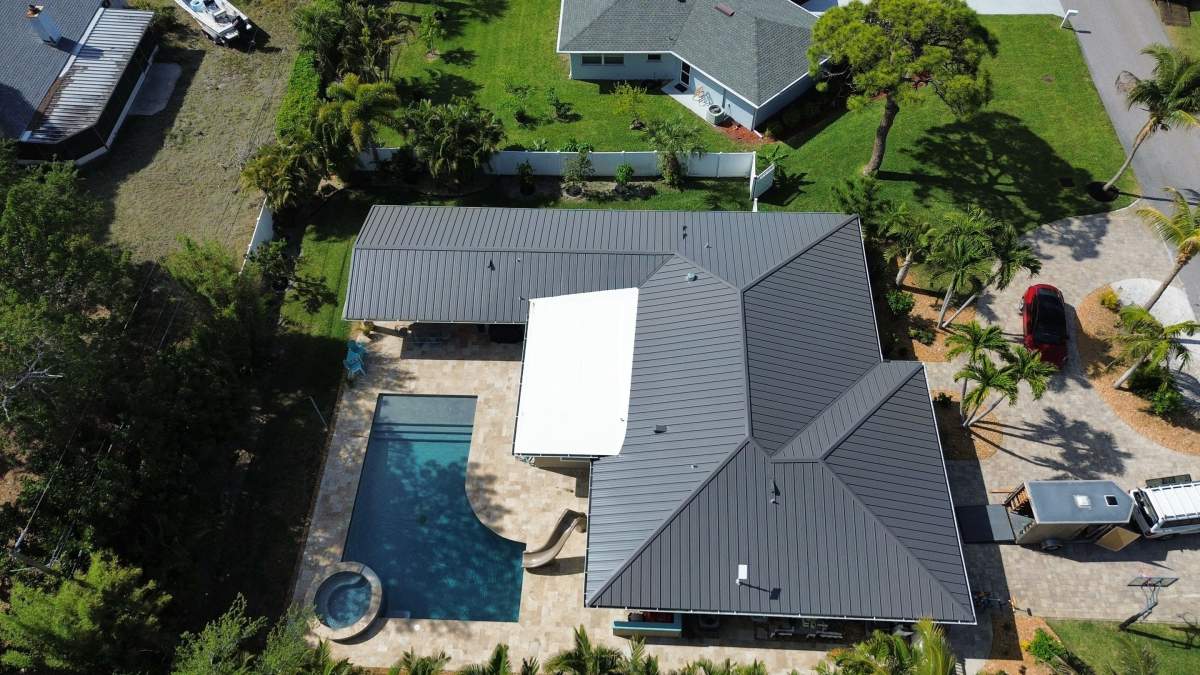
A close-up photograph of a standing seam metal roof on a coastal home, showing the concealed fastener system and clean vertical panels under bright sunlight
Panels run vertically from eave to ridge, and each seam is mechanically crimped or snapped together. That continuous interlock creates a structural connection across the whole roof rather than individual fastening points, which is why metal roofs hold up when shingles fail.
Metal gauge drives performance. Thicker panels resist bending and denting better under wind-borne debris. Corrosion resistance matters just as much in coastal air, where salt accelerates the breakdown of lesser metals. Aluminum and coated steel handle that environment well; bare steel does not.
The trade-off is upfront cost and, on some homes, noise during heavy rain. Both are manageable with proper underlayment and roof decking attachment.
Impact-Resistant Roofing Shingles: Class 4 Hail and Wind Defense
Impact-resistant roofing shingles are the practical middle ground for homeowners who want storm protection without a metal roof budget. They carry a Class 4 impact rating, meaning they withstand a large steel ball dropped from height without cracking, the standard proxy for severe hail.
Modern impact-resistant shingles use a reinforced mat and modified asphalt layer that absorbs impact rather than fracturing. After a storm, standard shingles crack and expose the underlayment while impact-rated shingles stay intact, often the difference between a full replacement and a minor repair.
Wind performance is separate from impact performance, so check both. Look for products tested under ASTM D3161 at the highest wind speed class, and confirm the installation uses the manufacturer’s enhanced nailing pattern.
Class H shingles, which meet a higher wind standard, are worth the upgrade in exposed locations; the cost difference is modest next to replacing a roof after every major storm.
Concrete and Clay Tile Performance in High-Wind Zones
Concrete and clay tile perform well in high-wind zones, but only when the attachment method is upgraded. The tiles are heavy and durable, and their weight resists wind uplift, but standard attachment relies on mortar or single fasteners that fail under sustained pressure.
In hurricane-prone areas, tiles should be mechanically fastened and often foam-adhered as a secondary connection.
|
Material |
Wind Uplift Resistance |
Impact Rating |
Best For |
|---|---|---|---|
|
Standing seam metal |
Highest |
Varies by gauge |
Maximum wind exposure |
|
Impact-resistant shingles |
High |
Class 4 |
Balanced cost and protection |
|
Concrete and clay tile |
High with upgraded fastening |
Good, but brittle |
Homes with structural support |
|
Standard asphalt shingles |
Moderate |
Class 1-3 |
Calm inland areas |
Florida Building Code Roofing Requirements and Fortified Standards
Florida Building Code roofing requirements set the minimum wind-resistance standard, and they are stricter than most of the country. The code ties roof covering approval to specific wind speed zones, so a material that works inland may not be approved for a coastal property.
Roof Maintenance for Storm Season: Retrofitting vs. Full Replacement
Roof maintenance for storm season comes down to one decision: retrofit what you have, or replace it. The retrofit path is real, cheaper, and for a structurally sound roof can raise storm performance substantially without a tear-off. The right answer depends on the age and condition of the existing roof, not a contractor’s sales target, and the way to tell the difference is to inspect the parts that fail first.
- Secondary water barrier. Adding a peel-and-stick or self-adhered underlayment beneath the covering is the single highest-value retrofit. It is what keeps wind-driven rain out of the attic when water gets past the covering, and it is required for FORTIFIED designation.
- Enhanced edge and perimeter fastening. Upgrading the attachment at the eaves, rakes, and ridge, where uplift pressure is highest, reduces the chance the covering peels from the edge inward.
- Ring-shank nails and a tighter nailing pattern. Where the covering is being re-nailed or replaced in sections, ring-shank nails and the manufacturer’s enhanced nailing pattern hold far better than smooth-shank nails under uplift.
- Sealed roof deck. Taping the deck seams before the underlayment goes down creates a continuous secondary barrier, a core FORTIFIED practice.
- Soft or spongy decking, which signals moisture damage and points to replacement.
- Rusted, corroded, or loose fasteners, which signal attachment failure and can often be corrected by a retrofit.
- Cracked or missing shingles, which may be isolated damage (repair) or widespread (replace).
- Existing underlayment condition, if there is no secondary barrier and the deck is sound, a retrofit adds real value.
- Roof age relative to the covering’s expected service life.
Cost vs. Durability: Long-Term ROI and Insurance Savings
The best roofing materials for hurricane zones usually cost more upfront and less over time. That calculation becomes useful when you break it into three levers: installed cost, expected service life, and the insurance and claims side of the ledger.
- Impact-resistant rating. A Class 4 impact rating (tested under UL 2218) signals to an insurer that the roof is less likely to be totaled by hail or wind-borne debris. Many carriers offer a premium credit or discount for a Class 4 covering, and the credit often applies every year the roof is in place, not just at installation.
- Fortified construction. The FORTIFIED program from the Insurance Institute for Business & Home Safety defines installation practices, enhanced deck attachment, a sealed roof deck, and a secondary water barrier, that measurably improve a roof’s odds of staying on in a storm. Some insurers recognize FORTIFIED designations with their own discounts, and a few extend the recognition to the whole-home designation, not just the roof.
Frequently Asked Questions
What type of roofing material is best for high winds?
Standing seam metal roofing offers the highest wind uplift resistance, withstanding gusts up to 140 mph or more depending on gauge and installation. Impact-resistant shingles rated Class 4 also perform well, resisting wind-borne debris. Concrete and clay tiles provide good wind resistance when properly fastened. The best choice depends on your roof pitch, budget, and whether you need to meet Florida Building Code roofing requirements for high-velocity hurricane zones.
How do impact-resistant shingles compare to metal roofing in storms?
Impact-resistant roofing shingles are tested to ASTM D3161 and UL 2218 Class 4 standards, meaning they resist hail and wind-borne debris without cracking. Metal roofing, however, offers superior wind uplift resistance because of its concealed fastener system and interlocking panels. Metal also reflects heat, reducing cooling costs. Shingles cost less upfront and are easier to repair, but metal typically lasts longer and may qualify for larger insurance discounts in hurricane zones.
Are there specific building codes for roofing in high-wind zones?
Yes. The Florida Building Code roofing requirements mandate specific fastening patterns, secondary water barriers, and product approvals for high-velocity hurricane zones. Roofs must meet ASTM testing standards for wind uplift and impact. Many jurisdictions also require a secondary water barrier under the primary roof covering to prevent moisture infiltration if the outer layer fails. Compliance is verified during inspection, and non-compliant roofs may not qualify for insurance or may fail to pass a wind mitigation inspection.
What roof design features help mitigate wind uplift during a hurricane?
Hip roof geometry performs better than gable roofs because the sloping sides deflect wind rather than catching it. A low slope roof reduces uplift pressure. Proper roof decking attachment with ring-shank nails, a secondary water barrier, and a concealed fastener system on metal roofs all improve wind load capacity. Ventilation systems must also be designed to equalize pressure and prevent internal pressurization that can push the roof off from underneath.


