


Table of Contents
- What to Look for in the Best Roofing Contractors in Manatee County
- How to Choose a Roofing Company: A Step-by-Step Vetting Process
- Roof Inspection Checklist: What a Thorough Evaluation Covers
- Residential Roofing Replacement: Materials That Hold Up in Florida
- Roof Repair vs. Replacement: When Each Option Makes Sense
- Storm Damage and Insurance Claims: What Manatee County Homeowners Should Know
- Why Blue Collar Roofing Stands Out Among Manatee County Roofing Contractors
- Frequently Asked Questions
Last Updated: September 29, 2026
What to Look for in the Best Roofing Contractors in Manatee County
Finding the best roofing contractors in Manatee County starts with three non-negotiables: a valid state license, proof of insurance, and a written estimate that itemizes materials and labor. Skip any one of those, and you’re gambling with your home.
- State license with a number you can verify in minutes
- General liability and workers’ comp coverage for every crew member on site
- Local address and references from jobs in your own neighborhood
- Written scope of work that names materials, timelines, and payment terms
- Manufacturer certifications that keep warranties valid after installation
The most common mistake homeowners make is accepting a verbal estimate. Without a written scope, a “small repair” can quietly become a full replacement once work starts, and you have no documentation to fall back on.
How to Choose a Roofing Company: A Step-by-Step Vetting Process
A structured vetting process takes about a week and saves months of regret. Follow these steps in order.
- Verify the license. Search the state database and confirm the license is active, not expired or suspended.
- Request proof of insurance. Ask for a certificate of insurance and call the insurer to confirm it is current.
- Get three written estimates. Each should break down materials, labor, timeline, and cleanup.
- Ask for local references. Call at least two homeowners whose roofs were done in the past year.
- Check for manufacturer certifications. These determine whether your warranty stays valid.
- Read the contract line by line. Look for payment schedules, change-order rules, and warranty terms.
- Confirm the crew. Ask whether the company uses its own employees or subcontractors.
Ask each contractor the same question: “What does your warranty cover, and who honors it if you’re no longer in business?” The answer tells you more about a company than any brochure.
Roof Inspection Checklist: What a Thorough Evaluation Covers
A proper roof inspection examines the shingles, underlayment, flashing, decking, and attic from the inside out, takes at least an hour, and produces a written report with photos.
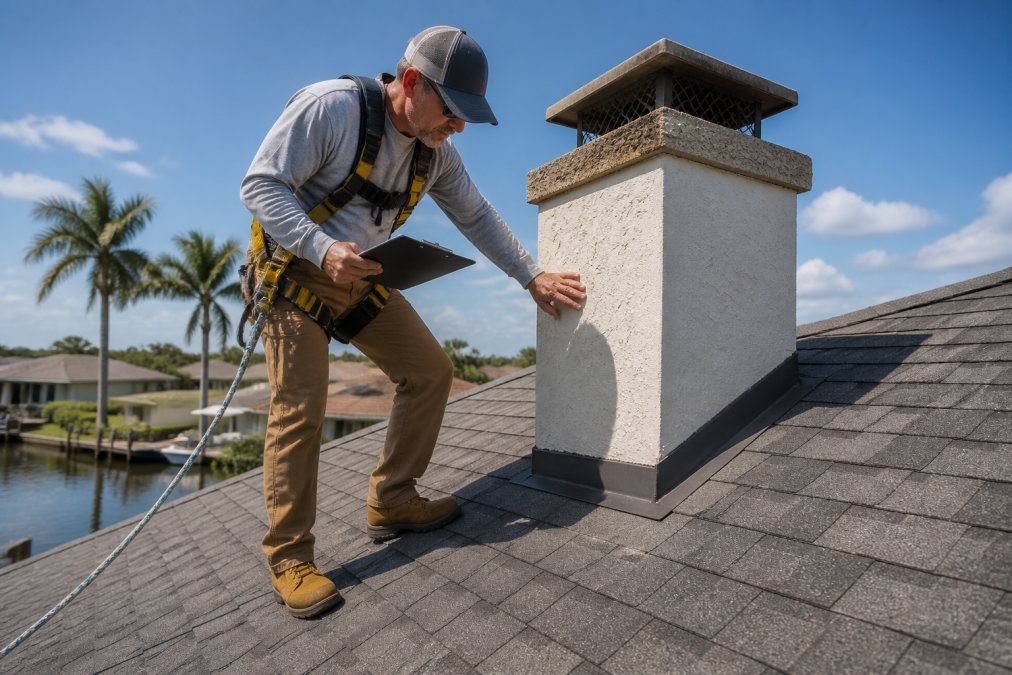
Here’s what a complete evaluation covers:
- Surface condition: cracked, curling, or missing shingles
- Flashing: seals around chimneys, vents, and valleys
- Attic ventilation: airflow that prevents heat and moisture buildup
- Decking: soft spots or sagging that signal rot
- Interior signs: water stains, daylight through the roof boards, or damp insulation
Attic, Decking, and Flashing Checks Most Homeowners Miss
The attic tells the real story. Staining on the underside of roof boards, rusted nails, or damp insulation point to leaks developing for months, long before a ceiling stain appears.
Residential Roofing Replacement: Materials That Hold Up in Florida
Asphalt shingles remain the most common choice for residential roofing replacement, but Florida’s heat, humidity, and wind demand specific product ratings, look for high wind-speed ratings and a manufacturer warranty that covers them.
The main options break down like this:
| Material | Lifespan | Best For | Trade-Off |
|---|---|---|---|
| Asphalt shingles | 15-25 years | Most homes, budget-conscious owners | Shorter life in intense sun |
| Metal roofing | 40-70 years | Long-term owners, coastal exposure | Higher upfront investment |
| Tile | 50+ years | Mediterranean and Spanish-style homes | Heavy; may need structural review |
| Flat membrane systems | 15-30 years | Low-slope and commercial roofs | Not suited to steep pitches |
The right material is the one that matches your roof pitch, your budget, and how long you plan to stay in the home. There is no single best option for every house.
Roof Repair vs. Replacement: When Each Option Makes Sense
The decision depends on three things: how widespread the damage is, how old the roof is relative to its expected service life, and whether the underlying cause has been fixed. A 12-year-old roof with one isolated leak differs from one with granule loss across every slope.
A Decision Framework You Can Apply
Work through these questions in order:
- Is the damage isolated or widespread? One slope, one penetration, one flashing point, repair. Multiple slopes, multiple leak locations, or damage that keeps reappearing, replacement.
- How old is the roof relative to its expected life? A roof at 80% or more of its expected service life with active damage usually does not justify a repair that will be undone by the next storm.
- Has the cause been identified and corrected? Repairing shingles over unresolved flashing or ventilation problems is a temporary fix.
- Is the decking sound? Soft spots, sagging, or rot in the roof boards mean the repair is bigger than the surface suggests.
- What does your insurance position look like? If a claim is open, the scope the insurer agrees to will shape whether a repair or replacement is the practical path.
Material-Specific Failure Signals
Different materials fail in different ways, and the signals matter when deciding whether to repair or replace.
| Material | What Failure Looks Like | Repair vs. Replace Threshold |
|---|---|---|
| Asphalt shingles | Granule loss in the valleys, curling edges, cracked or missing tabs, exposed mat | Isolated tabs: repair. Widespread granule loss or brittleness across slopes: replace |
| Metal | Loose or lifted fasteners, surface rust at penetrations, sealant failure at seams | Localized fastener and sealant issues: repair. Widespread rust or panel deformation: replace |
| Tile | Cracked or slipped tiles, broken pieces after wind, deteriorated underlayment beneath intact tile | Individual cracked tiles: repair. Underlayment failure under intact tile: replace the underlayment |
| Flat membrane | Blisters, ponding, seam separation, punctures | Small punctures or seams: repair. Widespread blistering or ponding: replace |
The Questions to Ask Your Contractor
- “What is the specific cause of this leak, and how do you know?”
- “If you repair it, what is the realistic lifespan of that repair?”
- “If this were your house, what would you do, and why?”
- “What does the warranty cover on a repair versus a replacement?”
- “Will the repair affect my manufacturer warranty on the rest of the roof?”
That last question catches people off guard: on some manufacturer warranties, a repair by a non-certified contractor or with non-matching materials can void coverage on the surrounding roof.
Repair is the right call when the damage is isolated, the cause is identified, and the roof has meaningful service life left. Replacement is the right call when damage is widespread, the roof is near the end of its expected life, or the underlying layer has failed. A contractor who can explain which situation you are in, with photos and reasoning, is the one to hire.
Storm Damage and Insurance Claims: What Manatee County Homeowners Should Know
Here is the sequence that actually moves a storm claim forward, plus where homeowners most often lose leverage.
Before You Touch Anything
Document first, repair second. Photograph damage from the ground, the attic, and any interior ceiling or wall stains, and note the storm date and when you noticed each issue. For emergency repairs to stop active water intrusion, photograph the damage first and keep receipts and materials. Insurers distinguish emergency mitigation (expected) from permanent repairs (which should wait until the adjuster sees the damage).
The Claim Sequence That Works
- Open the claim promptly. Florida policies typically require prompt notice of a loss. Waiting weeks or months gives the insurer grounds to question whether the damage is storm-related.
- Get your own written inspection. A licensed contractor’s report with dated photos gives you an independent record before the adjuster arrives.
- Attend the adjuster inspection. Be present, walk the roof with the adjuster if safe, and point out every area in your contractor’s report.
- Compare the adjuster’s scope to your contractor’s scope. Line items get missed, flashing, decking, underlayment, ventilation. A scope listing only shingle squares is usually incomplete.
- Review the settlement breakdown. Understand what’s paid as actual cash value versus replacement cost, and what depreciation is withheld until work is complete.
- Submit a supplement if the scope is short. A supplement formally requests missed or underpaid line items. It’s routine, not adversarial.
- Don’t authorize permanent work until the scope is agreed. Once the roof is replaced, negotiating missed items gets harder.
Terms Homeowners Get Tripped Up On
- Deductible: what you pay before the insurer pays. In Florida, the deductible for a hurricane loss is often a percentage of the dwelling limit rather than a flat dollar figure, so read your declarations page.
- Actual cash value vs. replacement cost: ACV pays today’s value minus depreciation; replacement cost pays what it takes to rebuild. Many policies pay ACV first and release the depreciation holdback after the work is done and invoiced.
- Matching: if only part of a roof slope is damaged, whether the insurer will pay to match the undamaged portion depends on your policy language and the adjuster’s judgment.
- Claim deadlines: Florida law sets timelines for how quickly an insurer must acknowledge, investigate, and pay or deny a claim. The specifics have changed recently, so confirm current rules with the state regulator.
Florida Office of Insurance Regulation consumer resources
What Your Contractor Should Do For You
A contractor who has worked storm claims before will:
- Provide a written, photo-documented inspection report you can submit with the claim
- Meet the adjuster on site and walk the roof with them
- Prepare a line-item scope in the same format the insurer uses
- File supplements when items are missed
- Never ask you to sign a document assigning your claim rights or agreeing to pay whatever the insurer approves
That last point is the one to watch: if a contractor asks you to sign anything assigning benefits or locking in pricing before the scope is agreed, stop and read it carefully.
Be cautious of any contractor who offers to “handle the whole claim for you” or who asks you to sign a document you have not read. You are the policyholder; the claim is yours. A good contractor supports your claim, they do not take it over.
After the Work Is Done
Keep every document: inspection report, adjuster’s scope, contractor invoice, certificate of completion, and photos of the finished roof. If you sell, buyers and their insurers will ask for proof the work was permitted and inspected.
Why Blue Collar Roofing Stands Out Among Manatee County Roofing Contractors
Homeowners who want a straight answer about repair versus replacement, and who value a local team they can call back if something needs attention.
Licensed and insured, with license LIC#CCC1334489, Blue Collar Roofing handles residential and commercial roofing, from emergency repairs to full replacements, inspections, and ongoing maintenance.
Frequently Asked Questions
How do I verify a roofing contractor’s license in Florida?
Florida requires roofing contractors to hold a state license through the Department of Business and Professional Regulation (DBPR), or a local license in some counties. Ask for the license number, then look it up on the DBPR website to confirm it is active and in good standing. Also request a certificate of insurance for general liability and workers’ compensation. A legitimate roofing professional will share these without hesitation. Blue Collar Roofing holds license #CCC1334489.
What should I look for when hiring a roofing contractor?
Focus on four things: verifiable licensing and insurance, a written scope of work, local references you can actually call, and a clear warranty on both materials and labor. A thorough roof inspection should come before any estimate. Be cautious of contractors who pressure you to sign on the spot, demand large upfront payments, or offer to waive your insurance deductible, which is illegal in Florida. A trustworthy roofing company will put everything in writing.
What are the signs that a roof needs to be replaced rather than repaired?
Age is the biggest factor. Asphalt shingle roofs in Florida typically last 15 to 20 years, and if yours is in that range, replacement is often more cost-effective than repeated repairs. Other signs include widespread granule loss, curling or cracked shingles, multiple active leaks, sagging decking, and daylight visible through the attic. A professional roof inspection can confirm whether the damage is isolated or systemic before you commit to a residential roofing replacement.
How long does a typical roof replacement take?
Most residential roof replacements take one to three days, depending on the size and pitch of the roof, the material selected, and weather conditions. Metal roofing and tile installations can take longer, sometimes a week or more. Expect noise and some debris during working hours, but a reputable crew will tarp landscaping, use magnetic sweepers for nails, and haul away old materials daily. Ask your contractor for a written timeline before work begins.
Roofing decisions carry real weight, and the wrong contractor turns a manageable repair into a months-long problem. Blue Collar Roofing offers three generations of craftsmanship, specialized leak detection, and honest assessments backed by a local team that stands behind its work. Get started with Blue Collar Roofing and get a clear, no-pressure evaluation of your roof.


